


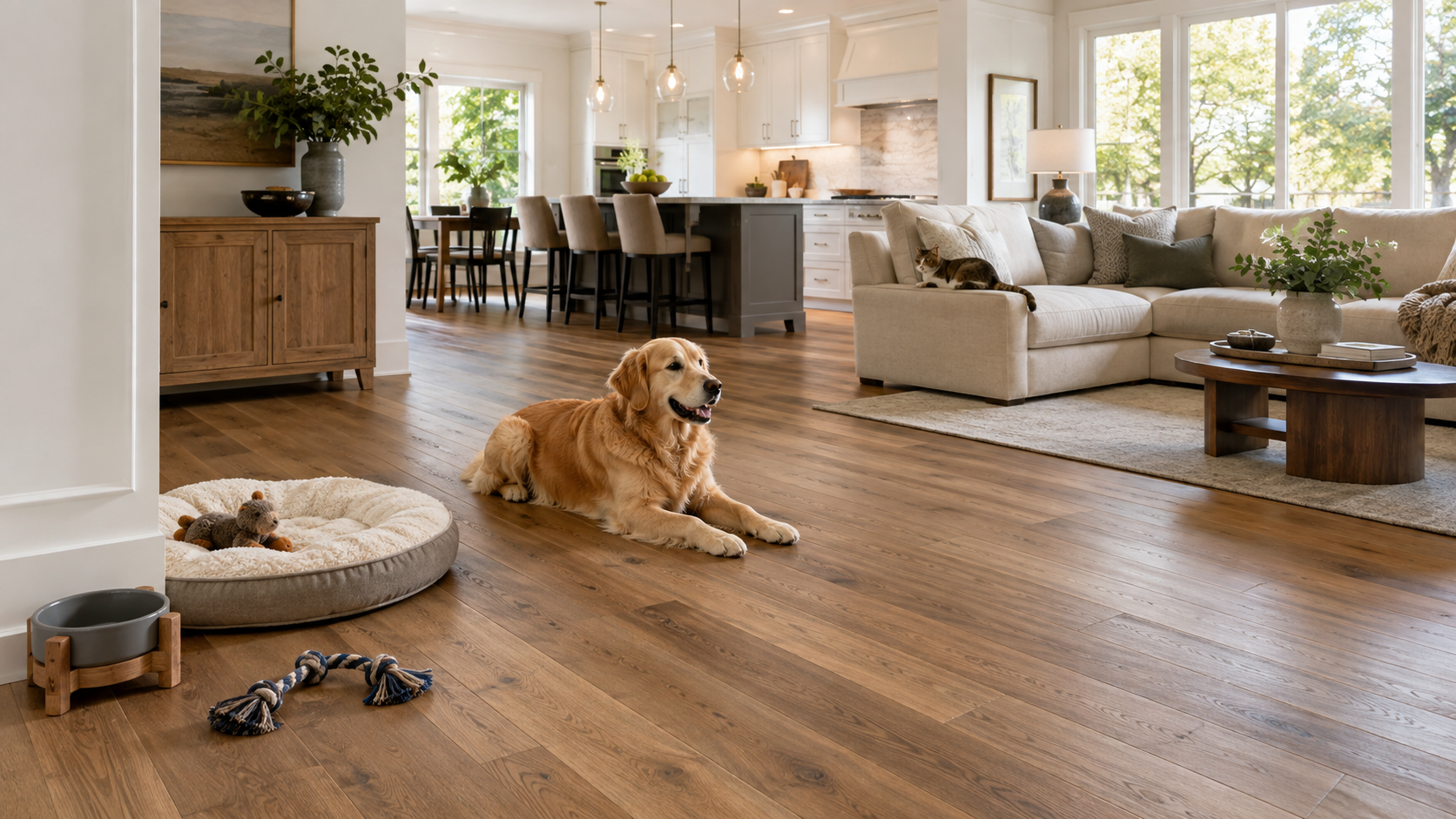
Hardwood flooring and pets can absolutely live together. The key is choosing a floor that suits the way your household actually functions rather than selecting wood based on appearance alone.
Dogs bring claws, muddy paws, water bowls, and the occasional burst of energy through the living room. Cats may race down hallways or knock water out of their bowls. Add Wisconsin's snow, rain, road grit, and seasonal mud, and a pet-friendly floor needs to handle more than ordinary foot traffic.
That does not mean pet owners in Kohler or Sheboygan need to give up on the warmth and character of real wood. Species, construction, finish, color, texture, and maintenance habits can all influence how well a hardwood floor fits an active home.
At Sheboygan Flooring and Furniture, homeowners can compare flooring styles with help from a local team that understands both design goals and the practical demands of Wisconsin households.
The best choice is not necessarily the hardest or darkest wood available. It is the option that balances durability, appearance, maintenance, and the personality of your home. If pets are part of the family, a few thoughtful decisions at the beginning can help you enjoy beautiful hardwood without feeling like every paw print or small mark is a crisis.
What Makes Hardwood Flooring Pet-Friendly?
No hardwood floor is completely resistant to scratches, moisture, dents, or everyday wear. Pet-friendly flooring is really about choosing characteristics that make normal signs of life less noticeable and easier to manage.
Several factors matter.
Wood Hardness
Different wood species have different levels of hardness. A harder wood can generally resist dents and surface impressions better than a softer species, although hardness alone does not make a floor scratch-proof.
For pet owners, this matters most in areas where dogs frequently run, jump from furniture, or change direction quickly.
Harder species may be worth considering for:
Family rooms
Hallways
Kitchens
Open living spaces
Entry areas
Homes with large or highly active dogs
However, the wood species is only one part of the decision. The surface finish, texture, plank color, and maintenance routine can influence everyday appearance just as much.
Finish Quality
The finish forms the protective surface over the wood and plays an important role in everyday performance.
Different hardwood products use different finishing systems, so ask about the manufacturer's recommendations and product specifications rather than assuming all hardwood behaves the same way.
A quality factory-applied finish can provide useful protection from routine household activity, but no finish makes hardwood immune to sharp claws, standing water, or heavy impacts.
Color and Grain Variation
A highly uniform, very dark floor can show dust, pet hair, and minor surface marks more readily than a floor with natural grain movement and moderate color variation.
Wood with visible grain can be forgiving because normal signs of use blend more naturally into the overall appearance.
That makes appearance an important practical consideration, not just a style decision.
Choose Hardwood Species With Everyday Durability in Mind
Wood species can affect both the look and performance of the floor.
Pet owners often benefit from considering woods known for good everyday durability, particularly when larger dogs or active pets are part of the household.
Oak
Oak remains a popular hardwood choice because it combines recognizable wood character with practical versatility.
Its visible grain can help disguise minor marks that might stand out more clearly on a very smooth, uniform surface.
Oak is also available in a wide range of stains and styles, making it easier to coordinate with different interiors.
For busy homes, the combination of natural grain and broad design flexibility can make oak an appealing starting point.
Hickory
Hickory is known for pronounced grain patterns and strong natural color variation.
That visual movement can work especially well in active households because the floor already has plenty of character. Small signs of everyday use may blend more naturally into a varied surface than they would on a highly uniform floor.
Hickory also creates a distinctive look, so it tends to suit homeowners who appreciate a more expressive wood appearance.
Maple
Maple offers a cleaner, more subtle grain than oak or hickory.
Its smooth appearance works beautifully in contemporary and transitional homes, but that uniformity means surface marks may sometimes be easier to notice depending on the color and finish.
Pet owners who love maple do not necessarily need to avoid it. Instead, pay closer attention to finish, color, pet activity levels, and how much visible character you want the floor to develop over time.
Other Hardwood Options
There are many other wood species and constructions available, each with its own appearance and performance characteristics.
Rather than choosing solely from a general hardness ranking, compare the actual flooring products you are considering.
Ask about:
Surface finish
Manufacturer care instructions
Construction
Warranty requirements
Texture
Color variation
Recommended installation areas
The complete product matters more than one specification viewed in isolation.
Consider Engineered Hardwood for Active Wisconsin Homes
Homeowners sometimes assume that "hardwood" always means one solid piece of wood from top to bottom. In reality, hardwood flooring may be available in solid and engineered constructions.
Engineered hardwood has a real wood surface layer over a layered core structure.
That construction can offer practical advantages in certain installations, particularly where environmental conditions or subfloor requirements make dimensional stability an important consideration.
Why Construction Matters
Wisconsin homes experience substantial seasonal changes in temperature and indoor humidity.
Wood naturally responds to changes in its environment. Appropriate installation, indoor climate control, acclimation when required, and manufacturer guidance all matter.
Engineered products are designed differently from solid hardwood and may be suitable for installation situations where solid wood is not the preferred option.
That does not automatically make engineered hardwood the best choice for every pet owner. The specific product, wear layer, finish, installation method, and room conditions still need to be considered.
Pet Performance Still Depends on the Surface
The word "engineered" does not mean pet-proof.
Pets interact with the top surface of the floor, so the species, texture, finish, and maintenance recommendations remain important.
If your household includes a large dog, several pets, or particularly active animals, compare actual product specifications rather than relying only on the construction category.
Pick Colors and Textures That Make Everyday Marks Less Obvious
Pet-friendly design is partly about durability and partly about choosing a floor that does not highlight every sign of daily life.
The right color and texture can make a noticeable difference.
Mid-Tone Woods Are Often Forgiving
Extremely dark hardwood can look dramatic, but it may make light-colored pet hair, dust, and footprints more visible.
Very pale floors can have the opposite issue depending on the pet's coat color and the type of debris being tracked indoors.
Mid-tone woods often provide a practical middle ground.
Warm browns, natural oak tones, and moderately varied finishes can disguise everyday dust and small marks while still creating a classic hardwood appearance.
Natural Variation Can Be an Advantage
Pet owners may find that a floor with visible knots, grain movement, or color variation is easier to live with than a perfectly uniform surface.
Minor changes become part of the visual character rather than the only detail your eye notices.
If you like a natural, lived-in appearance, this can be particularly helpful.
Textured Surfaces Can Add Character
Some hardwood products have brushed, scraped, or otherwise textured surfaces.
Texture can add depth to the wood and may make small surface imperfections less noticeable than they would be on a highly smooth finish.
However, cleaning requirements can vary, so consider whether the texture suits your preferred maintenance routine.
When comparing hardwood flooring, look beyond the sample's color and ask how its grain, texture, construction, and finish fit the way your pets move through the home.
Protect Hardwood From Claws Without Changing How Your Pets Live
A pet-friendly floor should support normal family life. You should not feel as though the dog needs permission to walk across the living room.
Basic preventive care can reduce unnecessary wear while allowing pets to use the home normally.
Keep Nails Maintained
Regular nail care is one of the simplest ways to reduce sharp contact with hardwood.
Long nails are more likely to make noticeable contact when a dog runs, jumps, or suddenly changes direction.
Appropriate nail maintenance also supports a pet's general comfort and mobility, so it is useful beyond flooring care.
Pay Attention to High-Energy Zones
Most pets do not move through every part of the house with equal intensity.
You may notice common "launch zones" such as:
The area near an exterior door
The hallway when someone comes home
The route to a food bowl
The space beside a favorite window
The area around the sofa
The path to the backyard
If one location gets particularly energetic use, consider an appropriate rug or runner to help protect that concentrated area.
Make sure rug pads or backing materials are approved for use with your hardwood finish.
Use Protective Pads Under Furniture
Pets are not the only source of scratches.
Furniture can shift when a dog bumps into a chair or when people move pieces during daily use.
Suitable protective pads beneath chair, table, sofa, and other furniture legs can reduce unnecessary friction against the floor.
Check pads periodically because they can collect grit or wear down over time.
Manage Water Bowls, Muddy Paws, and Wisconsin Weather
For pet owners, moisture management often matters as much as scratch prevention.
Hardwood is a natural material, and standing water should generally be addressed promptly.
Create a Practical Water-Bowl Station
Pets rarely drink without spilling at least a little water.
Place bowls in a location where you can notice and clean spills easily. Consider using an appropriate mat beneath the bowls, provided its backing is suitable for the hardwood floor.
Check underneath the mat regularly rather than assuming it is dry.
Water can sometimes become trapped beneath an item even when the visible surface looks fine.
Wipe Wet Paws at the Door
Wisconsin weather gives pets plenty of opportunities to bring moisture indoors.
Snowy paws, spring mud, summer rain, and damp fall leaves can all make their way onto the floor.
Keeping an absorbent towel near frequently used entrances makes paw cleanup easier.
You do not need a complicated routine. A quick wipe before the dog runs through the house can prevent moisture and grit from spreading across multiple rooms.
Deal With Accidents Promptly
Pet accidents happen.
Address them promptly and clean the area according to the hardwood manufacturer's instructions.
Avoid automatically reaching for strong household chemicals, abrasive cleaners, or large amounts of water. A product that works on another surface may not be suitable for a particular hardwood finish.
Product-specific care guidance is the safest reference.
Build a Pet-Friendly Hardwood Cleaning Routine
Pet households often need more frequent dry cleaning because fur, dirt, and grit accumulate quickly.
Fortunately, consistency matters more than intensity.
Remove Grit Regularly
Use a soft-bristle broom, microfiber dust mop, or vacuum setting suitable for hardwood.
Focus especially on:
Entryways
Hallways
Around food and water bowls
Favorite pet resting areas
Routes to exterior doors
Busy living spaces
Fine grit can act abrasively when people and pets repeatedly walk over it.
Removing it regularly helps keep it from being dragged across the finish.
Use Damp Cleaning Carefully
Follow the manufacturer's instructions for deeper cleaning.
Hardwood generally benefits from controlled moisture rather than excessive water. Avoid leaving standing liquid or soaking the surface during routine cleaning.
If your flooring manufacturer recommends a specific cleaner or cleaning method, follow that guidance.
Avoid Unapproved Products
Not every cleaner marketed for floors is suitable for every hardwood finish.
Before using:
Polishes
Waxes
Oil treatments
Steam equipment
Strong disinfectants
Homemade cleaning mixtures
check the manufacturer's care recommendations.
Adding an unsuitable product can leave residue or affect the appearance of the finish.
Use Rugs Strategically in Busy Pet Areas
Area rugs and runners can provide practical protection without hiding the beauty of hardwood throughout the room.
The key is placing them where they solve a specific problem.
Useful locations include:
Exterior entrances
Long hallways
Under pet bowls
In front of sofas
Near frequently used pet beds
Under dining tables
In busy family-room zones
Choose rugs based on both appearance and maintenance.
A highly delicate rug may not be the ideal choice for a muddy entryway, while a durable, manageable rug can handle that role more comfortably.
Keep the Area Under Rugs Clean
Do not forget about the hardwood beneath the rug.
Lift rugs periodically and remove any grit that has worked its way underneath. Fine debris caught between a rug and the floor can create friction.
Also inspect pads and backing materials for wear.
If you notice discoloration or residue, stop using the product and check the flooring manufacturer's recommendations before trying to remove it.
Think About Your Pet Before You Choose the Floor
There is no single hardwood that is perfect for every pet owner because pets have very different habits.
A quiet indoor cat creates different flooring demands from two large dogs that regularly run between the living room and backyard.
Before choosing, think about your actual household.
For Large or Active Dogs
Prioritize overall durability, a quality finish, forgiving grain patterns, and practical colors.
You may also want to consider textured surfaces that do not emphasize every small mark.
For Smaller Dogs
Smaller pets may exert less force on the floor, but nail care, spills, and tracked-in debris still matter.
The same preventive habits remain useful.
For Cats
Cats may create less floor wear during normal walking, but energetic running, litter tracking, and water spills still need consideration.
Placing litter mats appropriately and removing tracked particles can help keep grit from spreading throughout the house.
For Multi-Pet Homes
More pets usually mean more fur, more traffic, and more opportunities for outdoor debris to enter.
Choose a flooring style you can comfortably maintain rather than one that looks perfect only immediately after cleaning.
A beautiful home should still feel easy to live in.
Choose a Floor You Will Still Love After It Develops Character
One of the most useful mindset shifts for pet owners is accepting that real hardwood is a natural surface.
Over years of family life, it can develop character.
That does not mean neglecting the flooring or accepting preventable damage. It means distinguishing between ordinary signs of use and serious flooring problems.
A tiny surface mark in a busy hallway may eventually become part of the home's story. Homeowners who expect a permanently untouched surface may find themselves monitoring every paw step instead of enjoying their space.
Choosing a forgiving species, grain pattern, color, and texture from the beginning can help you feel more comfortable with natural wear.
If significant damage, moisture-related changes, deep scratches, or unusual movement develops, professional advice may be appropriate. Avoid attempting aggressive repairs until you understand the cause and know what methods are suitable for that specific floor.
Find the Right Balance Between Pets and Beautiful Hardwood
Pet ownership does not automatically rule out hardwood flooring.
A successful choice comes from balancing appearance with practical everyday needs.
When comparing options for a Kohler or Sheboygan home, keep these priorities in mind:
Consider species and overall product durability.
Pay attention to the quality and type of finish.
Look for grain patterns that can disguise minor everyday marks.
Consider mid-tone colors if visible pet hair and dust are concerns.
Compare solid and engineered constructions based on the installation area.
Maintain pet nails appropriately.
Remove grit, mud, and moisture promptly.
Protect concentrated traffic areas with suitable rugs where useful.
Follow manufacturer-approved cleaning and maintenance guidance.
Choose a floor whose natural character you genuinely enjoy.
The goal is not to find an indestructible floor. It is to find hardwood that fits your household well enough that you can appreciate its beauty while your pets continue being part of everyday family life.
For homeowners in Kohler, Sheboygan, and nearby Wisconsin communities, that might mean a naturally varied oak, a character-rich hickory, a carefully selected engineered hardwood, or another product chosen around the specific needs of the home.
If you are comparing hardwood options and want help finding one that suits your pets, lifestyle, and design preferences, get in touch with the team at Sheboygan Flooring and Furniture for personalized guidance.


